DMistica helps solve your sales challenges. From the first conversation to the signed contract, we automate the sales process to open new markets, generate new leads, build meaningful alliances and raise your conversion rates.
None of these are product problems. Every one of them is structural, which is the good news, because structure is fixable.
01
How many of your last ten deals would have closed without you in the room?
If the honest answer is one or two, that isn't a sales motion — that's you.
Pipeline is capped at your calendar. The day you're travelling, in a board meeting, or simply tired, it stops. And you can't hand it over, hire against it, or raise on it — because there's nothing to hand over.
What changesThe deal logic comes out of your head and into a system that runs without you. You stay in the room for the deals that need you, not all of them.
02
What did the SDR hire actually cost before the first real meeting?
Salary, ramp, and your time managing them. And it rarely fails because of the person.
You handed a junior a market they didn't understand, a story nobody had written yet, and a list nobody had validated. They learned the job on your warmest accounts — and those are the contacts you can't get back.
What changesProve the motion first. Then hire someone to operate a system that already works, instead of inventing one on your best contacts.
03
How many outbound touches went out last month — and how many became real conversations?
If the second number is a fraction of the first, the problem was never volume.
The instinct is to send more. But relevance is the constraint — you're sending a message written for a category to people who don't think they're in that category. The activity dashboard looks healthy while pipeline stays thin, which is exactly why it goes unfixed. It feels like work.
What changesFix what you say before you scale how much you send. Same volume, different reply rate.
04
When a qualified visitor lands on your site, what do you actually learn about them?
Usually nothing. The page asks them to book a demo, and few people are ready for that on a first visit.
So they read, they leave, and you never find out who they were or what brought them. You spent money and reputation getting them there. The page had one job.
What changesOffer something a buyer will genuinely do before they're ready to talk. They get real insight, you get a qualified record and a stated problem.
05
Of the people who book a demo, how many go quiet straight afterwards?
Two leaks with one cause — they booked before they had named the problem.
So the call becomes a product tour. Polite nods, no urgency, no next step — because nobody established what doing nothing was costing them. You optimised for booking meetings instead of qualifying problems.
What changesQualify the problem before the calendar. Fewer meetings, and the ones you take are business conversations.
06
How many deals did Microsoft, AWS or Oracle sellers bring you last quarter?
If it's none — or one you sourced yourself and registered afterwards — the badge isn't producing anything.
Cloud sellers carry quota and a queue of ISVs competing for their attention. If they can't explain what you do in one sentence, you don't exist to them when the right customer conversation comes up. That's a packaging problem, not a relationship problem.
What changesSellers get a line they can repeat and an account list where you help them hit their number. The badge starts producing.
07
Of the partners you've signed, how many have closed anything?
Signing is easy. Everyone signs, because saying yes costs them nothing.
Meanwhile your team funds portal access, enablement calls and margin discussions for a channel producing silence. And the one or two partners who do sell hide the fact that the rest never will.
What changesQualify before you sign, enable properly, and find out early which partners are real — so you can invest in those and stop feeding the rest.
08
What's the plan for the Gulf — hire someone local, or find a partner?
Both are expensive bets on a market you haven't validated yet.
A local hire commits real money and a year before you know whether it was the wrong person or the wrong market. A partner search without a defined profile means you sign whoever says yes first — and the partner with capacity is usually the partner who isn't busy.
What changesTest the market with a structured motion before you commit it to a salary. Find out whether it's real, then invest behind the evidence.
09
Your biggest open deal went quiet. Do you know why?
When the answer is no, it usually means you were single-threaded.
One champion, no read on the buying committee, no visibility into procurement or the internal priority you're competing against. The deal didn't die — it stopped being anyone's problem inside their company, and you found out months later.
What changesMap the room you're not in. Engineer the objection before it's raised, and catch silence early enough to do something about it.
10
What did you forecast last quarter, and what did you actually close?
When the gap is wide, the instinct is to blame the deals. It's usually structural.
You're forecasting off gut feel and CRM stages that get updated to make pipeline review comfortable. So you can't plan hiring, you can't plan cash, and you can't tell a board anything you'd defend. That's a decision-system problem, not a sales problem.
What changesOne structure with real conversion data at every step. Pull the lever at the top and predict what comes out at the bottom.
Recognise one of these? The next step isn't a sales call.
Building traction in a new market requires more than outreach. Sustainable regional growth depends on local presence, direct market engagement, cloud co-selling and reseller activation working together to create consistent commercial momentum.
01 / Market Foundation
Build Market Presence
Establish regional credibility, local-market relevance and a consistent presence in priority expansion territories.
02 / Alliance
Activate Cloud & Co-Sell
Engage cloud sellers, alliance teams and strategic partners who can introduce, position and co-sell your solution into relevant accounts.
03 / Community
Mobilize Reseller Channels
Develop and enable regional resellers and local seller communities equipped to introduce, position and co-sell your solution.
04 / Execution
Convert Relationships to Revenue
Apply structured regional growth motions to move opportunities from initial conversations to qualified opportunities and signed contracts.
Strategy · Helix Framework
Get the plan right before the outreach starts.
Helix Framework is our strategy and mentoring practice. We work out who to reach, what to say and which route gets you there. Then we guide your team as it runs. Your people keep the customer and the close.
01Every engagement starts here
Helix Align
The map before the motion. Who your buyer really is, the story that wins them, and which accounts and partners to go after first.
Ideal customer and buyer rolesMarket story and positioningTarget accountsEcosystem and partner map
02Pick the route that fits
Outbound + Inbound
Create demand. Convert interest.
Reach the right buyers directly, then turn the people who show interest into real conversations.
Sell ToWho to reach and what to say
Sell MorePosts, webinars, pages and follow-up
Top of funnel
Middle
Bottom
NearBound
Borrow trust that already exists.
Work with the cloud sellers, resellers and partners your customers already trust, all the way to the deal.
Sell WithCo-sell with cloud and alliance teams
Sell ThroughResellers and partners who sell for you
Top of funnel
Middle
Bottom
03Choose how deep we go
Free
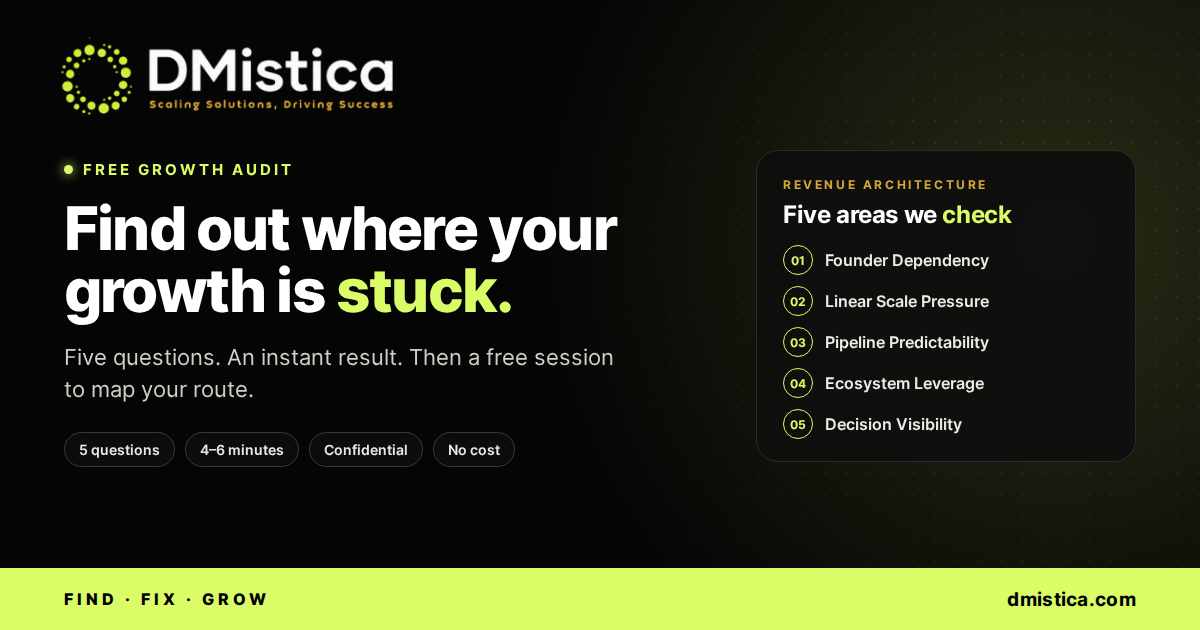
Growth Audit
A short audit and simulation session. Find out where growth is stuck and which route to start with.
Strategy only
Pure Strategy
We build the plan. Your team runs it on the tools you already use.
Helix Align for your market
A plan for each route: who to reach, what to say, how to measure it
No Helix OS needed
Bundle
Strategy + Helix OS Implementation
The same plan, then we implement it in Helix OS, inside your own account.
Everything in Pure Strategy
Your route's campaigns built and running
Bundled by route: Outbound + Inbound, NearBound, or both
Ongoing
Growth Mentoring
Regular reviews and coaching for your founder or sales lead once the plan is live. Adds on to either.
Helix OS is a library of ready-made sales campaigns, each built for one growth situation. A typical CRM records what happened. Helix OS does what should happen next.
Your situation is not on the list? The platform builds campaigns fast. Tell us the problem.
Middle East support · Helix DealFlow
Guidance to close deals in the Middle East.
A guide beside your team. We help you close deals, check regularly that your strategy and campaigns are working, and represent you at events, alliance offices and government programmes. Your team keeps the customer relationship and the close.
On-the-ground support for Middle East deals
Regular reviews of strategy and campaign performance
Representation at events, alliance offices and government programmes
Your team keeps the customer relationship and the close
We work with B2B software companies expanding into new regional markets, especially those building growth across customers, cloud alliances and channel ecosystems.
B2B SaaS companies entering new regional markets
Establish market relevance, structured routes to revenue and a repeatable expansion model.
ISVs seeking cross-border growth
Turn international expansion priorities into visible, coordinated commercial execution.
Cloud and technology ecosystem partners
Align seller communities, co-sell motions and target accounts across new markets.
AI software companies
Translate complex AI capabilities into clear regional value propositions and enterprise conversations.
Technology companies building channel relationships
Recruit, enable and activate regional resellers, referral partners and seller communities.
Companies with stalled market expansion
Rebuild momentum where pipeline, partner activity or commercial follow-up has slowed.
Mini Helix Simulator
See what your current sales motion could become.
Use a few simple inputs to compare your current motion with a structured Helix motion.
Your Current Sales Motion
Tell us how your sales funnel performs today.
Approximate figures are fine. Enter your monthly outreach volume, conversion rates and average contract value.
Type a number or move the slider.
How many new contacts do you actively reach in a typical month?
%
Of the contacts you reach, roughly what percentage do you successfully connect with?
%
From first connection or engagement, roughly what percentage turns into a qualified lead (MQL)?
%
Of your qualified leads, roughly what percentage become sales-qualified opportunities?
%
Of your sales-qualified opportunities, roughly what percentage convert to closed deals?
$
Average Contract Value (ACV) — Year 1.
Quarterly Funnel Comparison
Revenue shown annually
Metric
Your Current Motion
Helix Motion
Contacts Reached
—
—
Connections Made
—
—
Marketing Qualified Leads
—
—
Sales Qualified Opportunities
—
—
Closed Orders / Won Deals
—
—
Average Contract Value
—
—
Projected Annual Revenue
—
—
Enter your inputs above and press Simulate.
Schedule Your Helix Simulation Workshop
This mini simulation models Sell To + Sell More. In the full Helix Simulation Workshop, we can model your wider growth system — including Sell With and Sell Through — against your market, pipeline and deal economics.